
As of August 24, 2026, advertising has officially made its debut on ChatGPT in France, along with 30 other European markets. After six months of testing in the United States and then in a handful of pilot countries, OpenAI has taken a step that was by no means straightforward: transforming the world’s most widely used conversational tool into an advertising platform. At Daware, we’ve been following this story since OpenAI’s initial announcement in January 2026, guided by a simple principle: neither get carried away by the promise nor ignore the underlying trend. Here’s where this new channel really stands, what it’s capable of today, and what we still need to wait for before making a serious investment with a ChatGPT Ads Agency.
A launch that didn't come out of nowhere
It’s worth taking a closer look at the timeline, because it speaks volumes about OpenAI’s approach. The first advertising tests began in the United States in February 2026, then gradually expanded to eight pilot markets (Canada, the United Kingdom, Australia, New Zealand, Japan, South Korea, Brazil, and Mexico) before reaching Europe on August 24, covering 31 countries including France, Germany, Spain, Italy, and the Netherlands.
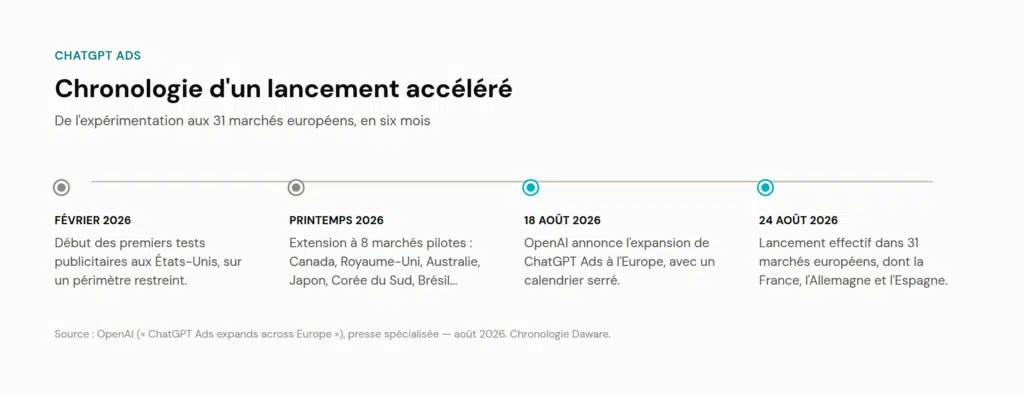
At the same time, the business model has been refined at each stage: first CPM auctions, then CPC auctions, and now’oCPC (conversion-optimized cost per click), a model that aligns ChatGPT Ads with the performance-based approaches already familiar from Google Ads or Meta Ads. OpenAI reported the following business results: approximately $100 million in annualized revenue generated in just six weeks after the pilot launch. This figure speaks to one thing above all: there is genuine interest among advertisers in testing this channel—without prejudging its long-term performance, which we’ll revisit later.
How Do ChatGPT Ads Actually Work?
In principle, OpenAI remains cautious: the ads are presented as sponsored content, visually identified (with a distinct background and the label «sponsored») and positioned below the response generated by the model—never mixed in with it. The company emphasizes a point it knows is sensitive: advertising would not influence the content of ChatGPT’s responses themselves, only the sponsored message that accompanies them.
Two clarifications have a tangible impact on the size of the audience:
Ads are displayed only to users of the offers Free and Go. Plus, Pro, Business, and Enterprise accounts remain in a completely ad-free environment, which effectively excludes some of the most engaged users—who are often the most valuable to target.
In terms of tools, advertisers already have access to geographic targeting, custom audiences, and measurement solutions (OpenAI Pixel and API Conversions) designed to integrate with existing tracking stacks.
Who can announce it, and who can't yet
This is the key point to keep in mind before making plans: the ads have been visible to French users since August 24, but advertiser access is not yet open to everyone. Initially, access is provided through the OpenAI Ads Solutions team, partner media agencies (several major international groups are already involved), or technology partners. A self-service Ads Manager, designed for smaller businesses, is expected to launch later this quarter.
In practical terms, this creates a unique window of opportunity: the channel exists, French consumers are aware of it, but not all brands can yet engage with it directly. It is precisely this window—between the announcement and widespread access—that deserves to be addressed in advance rather than discovered on the day self-service opens up to everyone at once.
A Critical Look: What the Market Is Already Saying
Curiosity does not mean naivety. Several warning signs, reported by analysts and advertisers who have tested the format in recent months, call for caution:
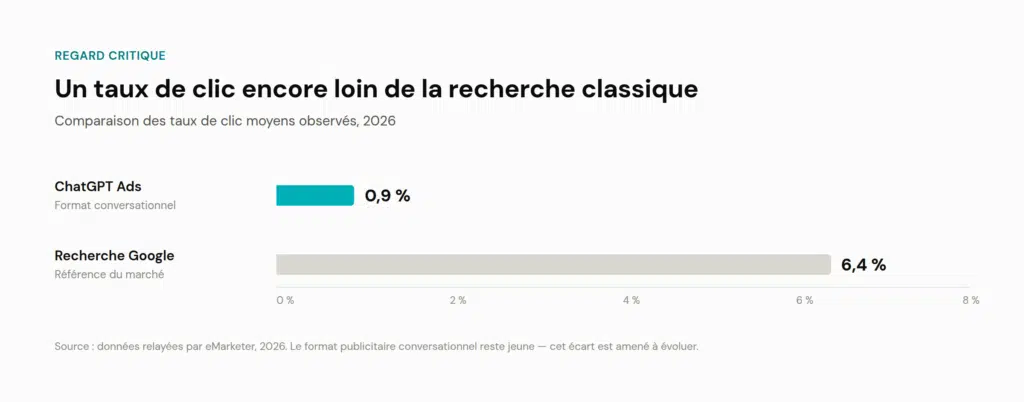
The average click-through rate observed for conversational ads is reportedly around 0.9 %, compared to approximately 6.4 % on Google Search—a discrepancy that raises questions about the true maturity of the conversational ad format.
Measurement tools are still in their infancy: several agency executives point to the lack of full-funnel reporting comparable to what Google Ads or Meta have been offering for years, as well as a lack of transparency regarding the auction process.
Targeting—which is still limited in terms of demographic and behavioral granularity compared to legacy platforms—makes it difficult to fine-tune campaigns.
Finally, several advertisers who have tested the format in pilot markets report that they do not yet have quantifiable evidence of a direct business impact; the initial interest appears to stem more from curiosity than from proven results.
This observation is not a reason to ignore the subject. It is a reason not to dive in headfirst, and to clearly distinguish between what is experimental and what is a mature acquisition channel.
And yet, it’s a question worth asking seriously
Today’s skepticism is nothing new: Google Ads, Meta Ads, and TikTok Ads all got off to a shaky start—with imperfect measurement tools and cautious advertisers—before becoming indispensable tools. What’s changing here is the nature of the interaction: ChatGPT captures searches phrased in natural language, which often reflect a well-formed purchase intent rather than a traditional search engine query. If the advertising format continues to evolve at the same pace as the other components of the product—which has been the case so far, given the rapid evolution of the bidding model—the question is no longer whether this channel will matter, but when and for which types of advertisers it will become relevant.
It’s also a matter of trust, not just performance. OpenAI has banned advertising on sensitive topics (health, mental health, politics), promises that no advertiser has access to users« conversations or personal data, and offers an option to disable targeted advertising. That said, the company itself acknowledges that it is »still learning” in this area—an honest statement that invites us to follow the platform’s evolution rather than view it as set in stone.
What This Really Changes in the User Journey
Let’s take a moment to step back and consider what’s really at stake, beyond the launch figures. A Google search returns a list of results that the user still has to sort through, compare, and click on, ChatGPT, on the other hand, eliminates this sorting step: the user arrives with a specific question, often formulated after several exchanges that have refined their needs («I’m looking for a folding e-bike for city commuting, with a budget of around €1,500»). This is a level of intent qualification that no traditional search engine achieves on the first query. An ad that appears at that moment isn’t aimed at a user who’s just browsing—it’s aimed at someone who’s already in the process of making a decision.
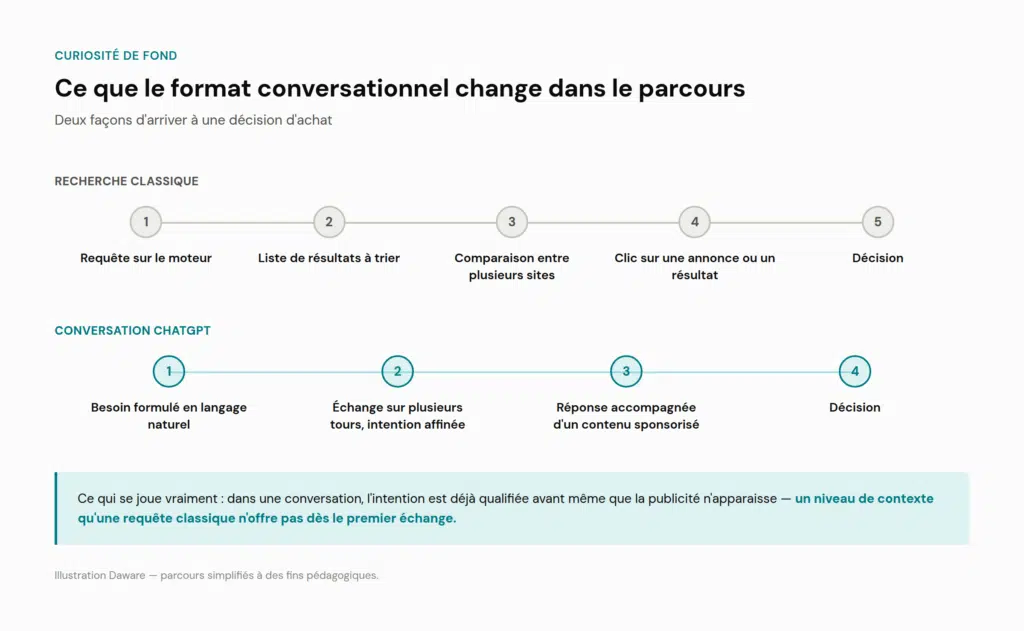
That is precisely what makes this topic so exciting for us, beyond the legitimate caution surrounding the current figures. The advertising format is new, but the environment in which it operates—a conversation where the user articulates their needs in their own words, often over several rounds of exchange—is one that traditional advertising has never had at its disposal. Brands that know how to structure their content to be included By using a conversational model—rather than simply being indexed by a search engine—they gain a significant head start, regardless of how quickly the advertising product itself matures.
Things We Can Start Doing Right Away
Without waiting for self-service access to become widespread, there are several initiatives that an ambitious brand can launch right now:
- Test on a small scale as soon as access allows. A modest test-and-learn budget, with clear conversion goals and KPIs defined in advance, allows you to learn how oCPC auctions actually work before competitors flood the channel.
- Rethink your product content to make it more conversational. Product pages, FAQs, sales pitches: the way a model understands and presents an offer differs from the way a search engine indexes it. This work benefits both advertising and organic visibility (GEO).
- Focus on high-intent search queries rather than brand awareness. The characteristics of the format (targeted conversations, ad-free audience excluded) now favor performance and conversion strategies over pure branding.
- Implement the measure starting with the very first euro spent. Integrate the OpenAI Pixel and Conversions API into your existing tracking architecture to objectively compare this channel with others, rather than judging it based solely on its native metrics.
None of this guarantees results; the channel has only been available in France for three days, so caution is still advised when it comes to performance promises. But preparing for it now, while access is still limited, means you’ll be ready when that’s no longer the case.
What This Means for French Brands
Two points to keep in mind for any company that is seriously considering this channel:
Direct access remains limited at launch: brands that want to test the platform early on will likely need to work with a partner rather than run their own campaign.
Advertising alone isn't enough. Being mentioned, viewed favorably, and accurately represented in ChatGPT's organic responses is a separate task, known as LLM visibility or GEO (Generative Engine Optimization). It is this upstream aspect—which is independent of the media budget—that distinguishes brands ready to capitalize on the channel as soon as it becomes widely available from those that will only discover it once everyone has access to it at the same time.
Our Position at Daware
We have been tracking this topic since OpenAI’s initial announcement, using the same approach we take with our other acquisition channels: document before recommending, measure before promising. Specifically, our support currently focuses on three areas:
- structuring your content and product data so that they can be used by conversational models; ;
- efforts to increase visibility in ChatGPT responses, prior to any advertising activation; ;
- Setting up tracking and measurement (Pixel, Conversions API) to manage this channel as soon as your access level allows it.
We’re ready, well-informed, and available to help ambitious companies that want to structure their approach to ChatGPT Ads right away—don’t hesitate to give us a call.


