 Dorian Hermosa
With the arrival of generative artificial intelligence in Google - and Search Generative Experience (SGE) in particular - the way results are displayed is changing radically. For SEO-focused sites, this is both a challenge and an opportunity. This shift is a perfect illustration of how Google is revolutionizing search with AI and redefines the codes of search engine optimization. In this article, we take an in-depth look at these changes, their concrete impact on online visibility and, above all, the technical and strategic levers you need to activate to remain competitive. Whether you're a site owner or a consultant GEO agencyHere are the keys to anticipating and taking advantage of this new landscape.
Discover also SEO challenges in the EMS era and opportunities for B2B companies.
SERP evolution under the influence of generative AI
Google now integrates AI-generated summaries directly at the top of search results. Launched in 2023-2024, the AI Overviews of the EMS provide a synthetic answer to the user's query, drawing on several web sources. This AI block appears before the traditional organic results (and sometimes even before the paid ads), marking Google's transition from a simple search engine to a "response engine focused on immediate information.
Fictitious example: for a factual question like " Why is the sky blue? "Google displays an AI insert at the top of the page, directly formulating the explanation sought. The user gets the answer without having to click on an external link. What's more, generative AI can integrate the following elements multi-modal (images, videos) to enrich the response, making the experience even more interactive and complete on the SERP itself.
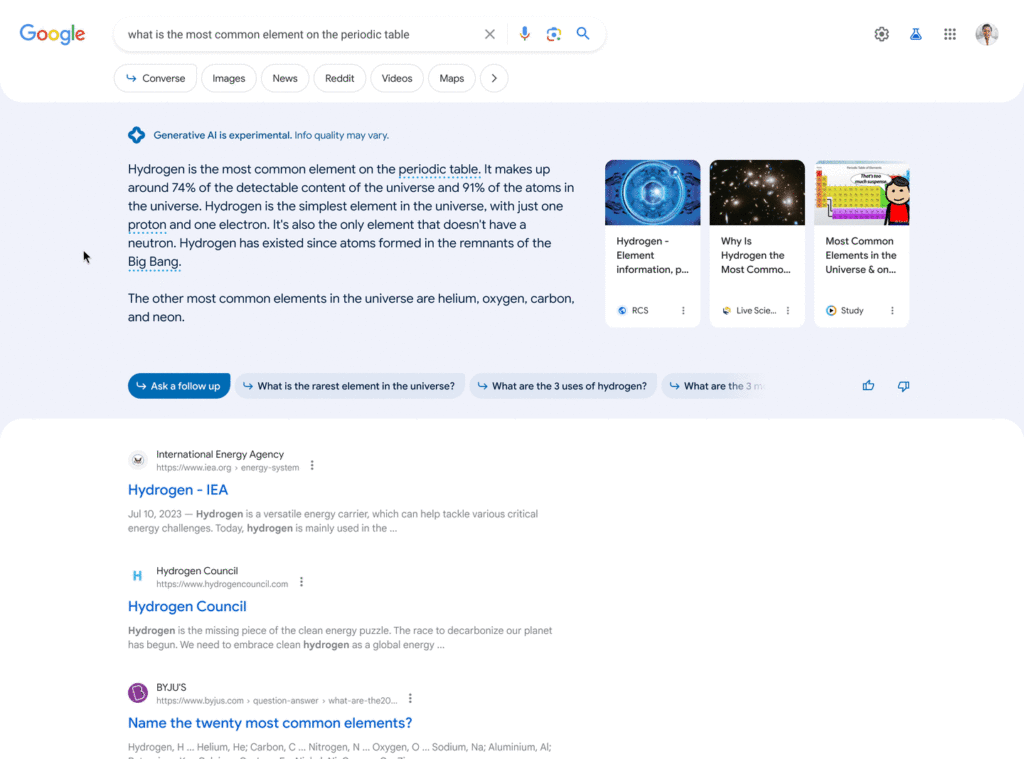
Overview of a SERP integrating Google's SGE (source: Abondance.com)
These technical developments have resulted in a drastically reduced click-through rate (CTR) to websites. About 60 % of Google searches now result in no click at all to an organic result, with the user finding the answer directly on the page. In other words, nearly 6 out of 10 queries result in zero clickscompared to just ~44 % a year ago (we're talking about zero click search. The first natural results are relegated much further down the page: some organic listings that used to be at the top of the page are no longer there. 1500+ pixel push-backs (equivalent to 2 to 3 full screens)This means the user has to scroll a long way to see them. Consequence: Even a site ranked #1 loses a large part of its visibility, resulting in a sharp drop in CTR for content that is well positioned. The rise of "direct answers (optimized extracts, information panels, EMS, etc.) thus confirms the trend of the "zero-clickGoogle is increasingly satisfying information needs within the SERP itself.
Google EMS not yet available in France
The Search Generative Experience (SGE) has yet to cross French borders. Since 2023, Google has been rolling out this new experience step by step: more than 120 countries already benefit from it, in several dozen languages, but France remains, like other European markets, on hold. There are several possible reasons behind this delay: constraints linked to the RGPD, the need to adapt linguistic and cultural models, or Google's strategic choice, which prefers to refine its product before introducing it to a market as sensitive as France.
In concrete terms, French Internet users are still browsing a "classic" SERP: featured snippets, knowledge panels, People Also Ask... but not yet a generative block at the top of the page. Yet signals from the USA, Asia and some European countries leave little room for doubt: sooner or later, EMS will arrive in France. For publishers and SEO agencies alike, this is a window of opportunity. By observing what's happening elsewhere now, you'll have a head start in adjusting your strategies before the wave reaches our market.
Effects of AI on organic website traffic
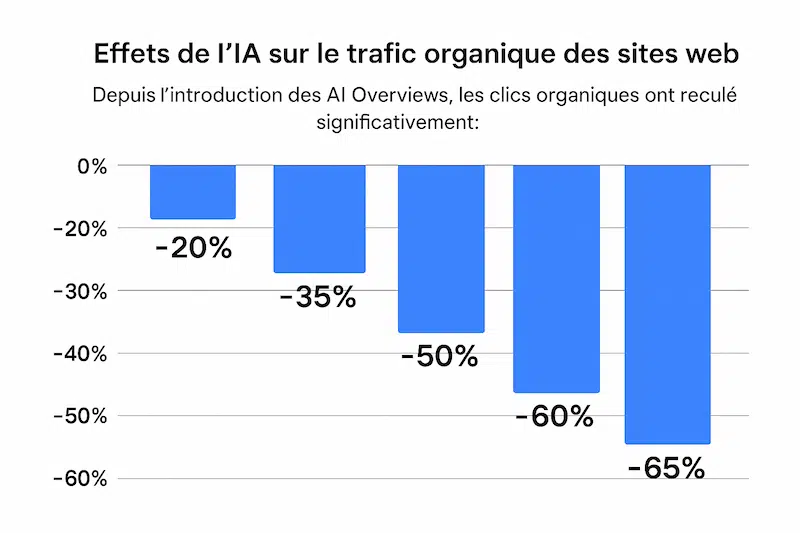
For sites investing in SEO, the impact on organic traffic is already significant. Numerous studies anticipate a significant drop in traffic from Google as a result of these AI responses. For example, analyses carried out prior to the general roll-out of EMS predicted a drop in 18 to 64 % of organic clicks depending on the sites and themes concerned. Some major web agencies estimate a drop of around 20 to 60 % of SEO traffic as generative AI becomes more widespread. In practice, since the introduction of AI Overviews in 2024, we've already seen a decline in natural traffic on many informative queries, correlated with the rise of no-click searches.
Types of sites and content most affected are those whose information can be easily summarized by AI. The pages of guides, tutorials, definitions or FAQs, which answer specific questions, are particularly relevant: Google can extract the essential information and present the answer directly in the SGE summary, eclipsing the organic links to the correspondent. For example, an affiliate site that lives on comparisons " Top 10 "or " Best X "In the same way, publishers of encyclopedic or news content, who used to attract traffic via generic questions, anticipate significant losses in visibility. Similarly, publishers of encyclopedic or news content who used to attract traffic via generic questions are anticipating significant losses in visibility.
On the other hand, some specific or sensitive requests seem less exposed to direct AI responses, at least at this stage. Google has been cautious about "Your Money Your Life" topics (health, finance, legal...), and queries transactional/local very targeted searches often continue to display classic results (product pages, local pack, etc.) without systematic generative search. For example, commercial searches such as "buy [product] near [city]" still rarely trigger an EMS block (less than 5 to 10 % of these requests would be accompanied by an AI response), focusing instead on local or Shopping results. As a matter of fact, very specific, local requests, or those with high purchase intent, are still less covered by SGE.This leaves untouched opportunities for organic traffic in these segments.
To find out more, discover how optimize your referencing in ChatGPT and generative engines to capture qualified traffic in the age of AI.
Moreover, in complex fields (technical B2B, SaaS, medicine, advanced finance, etc.), many users still have a very limited knowledge of the market. mistrust of AI answers and prefer to consult the sources in detail. We've also observed that visitors who click through despite the presence of an AI summary are often those who wish to delve deeper into the subject - a more qualified and engaged audience. These visitors, having already read the brief IA overview but wanted morearrive with a strong intention, resulting in higher conversion rates - up to 10 % in certain cases of AI search traffic. In short, if volume organic traffic is declining, the quality of residual traffic is tending to increase (more determined users, in search of complete information), which may partly compensate for the drop in quantity.
We also note a notoriety effect induced by AI responses: even without a click, the presence of a site or brand name in a generated extract can be valuable. Being cited as a source in an EMS block confers free brand visibility with web users. They memorize the name of the site appearing in the response, which may later lead them to search for it directly or to trust it. In this way, a SEO strategy in the age of AI must integrate this dimension of visibility without clicks: success is no longer measured solely in visits, but also in prints and impact on brand perception. With Google increasingly able to retain users in its ecosystem (via instant answers or follow-up suggestions in SGE), sites need to find ways to exist in these new ways of consulting information.
Technical recommendations for adapting SEO to the AI era
Faced with a decline in traditional organic traffic, SEO managers need to adapt their approach. The objective is twofold: make content eligible for AI responses (to be quoted or included in generative extracts) and provide users with sufficient added value to encourage them to click anyway. Here are some concrete technical recommendations:
- Finely structure content and improve readability. Well-structured content is more easily understood and exploited by AI algorithms. You need to organize your pages with a clear hierarchy (relevant H1, H2, H3 tags), clear short paragraphsThis formatting helps robots to quickly extract synthetic answers from your pages. This formatting helps robots to quickly extract synthetic answers from your pages. In addition, a fluid, natural text is recommended: no more keyword stuffing or heavy jargon: AI favors a conversational tone, close to a human discussion. By making content more readable and enjoyable (for both human and machine), you increase your chances of being selected in an AI Overview and of offering a good experience to human visitors.
- Reinforce content quality and E-E-A-T. More than ever, Google insists on theExperience, Expertise, Authoritativeness, Trust (E-E-A-T) of highlighted content. EMS answers are based on Google's usual ranking and quality systems, including the Helpful Content and therefore the E-E-A-T. Be sure to demonstrate your expertise in each article: mention the author with his or her qualifications, provide a unique viewpointInclude original data, case studies or concrete examples from your own experience. Support your assertions with reliable sources (external links to reference sites, up-to-date statistics) to reinforce the credibility of your words. Google values these signals of trust and authority enormously, even more so with SGE. Content deep, reliable and with high added value is far more likely to be picked up by the AI than a basic or generic text. In short, write first to meet the user's need in an expert way, while providing the algorithms with proof of your legitimacy (quotes, authoritative tone, highlighted experience).
- Anticipate related issues and cover overall user intent. AI Overviews are designed to give the surfer everything you need to understand a subjectlike a super featured snippet. It is therefore strategic to "supercharge" your content by answering secondary questions that the user might ask following their initial query. In concrete terms, integrate elements such as "People also ask..." or FAQ covering variants and sub-questions related to the topic. Use Google's suggestions (People Also Ask) or related searches, or even questions from user forums. For example, a main article might include sidebars such as Q/R to address these issues. This approach enables you to satisfy the research intention in its entiretyThis will please the algorithm (content deemed complete and relevant) and increase your chances of being the source that the AI cites for different facets of the subject. What's more, if the user consults an AI answer and then clicks on a follow-up question, your content could appear on these complementary queries. In short, anticipate the conversation Content that responds "as if in a natural discussion" by following on from the next need will be better positioned in the AI search era.
- Use markers and structured data (Schema.org). It is crucial to provide context for search engines via from structured data integrated into your pages. Tags schema help AI models to better understand the content and entities present. For example, Google's EMS relies in part on the Shopping Graph fed by merchant data and indexed product pages. So be sure to add the appropriate schemas: Product (product sheet with price, reviews, stock, etc.), FAQ (formatted questions and answers), HowTo, Organization (info about your company), LocalBusiness for a local business, etc. These tags provide Google with structured information that it can reuse directly in its responses. Well-tagged content (clear HTML titles, relevant JSON-LD microdata) will be "read" more efficiently by Google's AI. In short, make the engine's work easier by giving it your data on a platter: it's all the more reason to be potentially selected in an enriched result or generative preview.
- Enrich your pages with media (images, videos, audio). Google's AI models become multimodalThese are all tools capable of interpreting not only text, but also associated images or videos. Providing high-quality visual content on your pages can serve two purposes: firstly, the AI can integrate these visuals into the snapshot (or use them to validate a response), and secondly, these media give you visibility on other channels (Google Images, Google Videos) which are not yet saturated by generative AI. For example, an original diagram or infographic in your article can appear as a thumbnail illustration under the EMS block, encouraging users to click on the image to enlarge it and visit your site. Similarly, a well-optimized explanatory video could be proposed in the video results. Enrich textual content with unique and relevant media improves UX and provides Google with additional material to exploit, strengthening your presence on the multi-format SERP.
- Optimize what AI can't do (local and transactional queries, mobile navigation, etc.). Since some query categories are less well supported by generative responses, it is advisable to redouble our efforts in these protected segments. For example, make sure you have a excellent local optimization : sheet Google Business Profile (timetables, customer reviews, photos...), signposting LocalBusinesslocalized content - because local packs and "near me" searches remain highly cliquogenic in the absence of ubiquitous AI. Similarly, work on your pages to strong intent to buy (products, services, quote requests): Google tends not to synthesize these commercial queries too much in SGE, so this is an opportunity to capture as much organic traffic as possible on these high-converting keywords. At the same time, take care of all technical aspects classics (loading speed, mobile compatibility, Core Web Vitals) in order to maximize your chances of conversion when the qualified visitor arrives - each click gained will be all the more valuable the fewer opportunities there are. In short, focus your SEO on strategic queries not covered by AI to consolidate these still reliable traffic sources.
- Increase mentions of your site on third-party sources. Being present beyond your own site is an asset in an ecosystem where Google compiles answers from all over the web. Brand mentions, citations and quality backlinks can indirectly bring you traffic in the world of generative AI. In practice, Google may rely on a third-party article listing, for example, "the best apps from X" to compose its AI summary - if your product or site appears there, it will be named in the response. The user, seeing your name in the SGE block, might click on it or perform a dedicated search. It is therefore useful to nurturing your global digital presence This "off-site" work will also improve your link profile (traditional SEO), while increasing the chances of your brand being picked up by the AI as an authority on a given subject. This "off-site" work will also improve your link profile (traditional SEO) while increasing the chances of your brand being picked up by the AI as authoritative on a given subject.
By applying these optimizations, you increase your resilience in the face of declining organic traffic. The key idea is to "become THE answer that AI chooses to summarize and source". rather than simply "being #1 on Google". It's a paradigm shift where the the most useful, expert and structured content takes the cake in terms of generative results.
To find out more, take a look at our SEO strategies for dealing with AI to remain competitive in 2025.
Adjusting your SEO strategy in the face of AI: towards sustainable, multi-channel SEO
Over and above the purely technical aspects, the rise of AI in research calls for a new approach. strategic development for websites and brands. Here are the strategic areas to focus on:
- Diversify traffic acquisition channels. Given Google's increasing reliance on no-click responses, it's risky to rely solely on traditional organic SEO. It's important to adopt a multi-channel. In concrete terms, this means investing in other levers: social media, paid search (SEA), newsletters, content marketing on third-party platforms, podcasts, YouTube videos, etc. The aim is to reduce vulnerability to Google traffic loss by expanding your presence. As one analyst points out, the emergence of generative AI reinforces "the importance of a diversified brand presence, going beyond the single channel [of search]".. By developing your reputation on several platforms and building loyalty among your audience (via email subscriptions, online communities...), you create direct points of contact that compensate for the drop in visibility on Google. In short, you need to think beyond the search engine: go and find your audience where they are, rather than waiting for them to come on their own via an increasingly closed SERP.
- Focusing SEO on the user and added value. More than ever, a user-centric strategy is needed. Google is no longer simply looking for pages optimized for its algorithms; it is "choosing" content capable of providing a real response to the user. This means creating content that designed with the user experience in mind - useful, up-to-date, engaging - rather than pursuing old recipes for over-optimization. "Don't try to be first on Google, try to be chosen by AI. To achieve this, focus on excellent content, designed as a real answer for the user". sums up the new philosophy perfectly. In concrete terms, this means identifying the intention behind each targeted query (informative, comparative, transactional, etc.) and responding to it better than anyone else, going further than the AI's generic response if possible. For example, for a query on a specific problem, providing personalized adviceand proprietary data or a expert angle will set us apart from standardized AI synthesis. This involves create value that AI alone cannot deliver - whether through creativity, human expertise or depth of content.
- Build a strong, trusted brand. Eventually, the brand strength will be a major bulwark against AI-driven disintermediation. If your site is recognized as referent in its field, users will voluntarily search for your content (for example, by adding the site's name to their searches), and Google/IA will tend to cite you first. So you need to invest in reputation and the trust A well-established brand presence increases the likelihood that your information will be picked up by AI models (via the Knowledge Graph, for example), and that users will click on you when they see you in the SERP. A well-established brand presence increases the likelihood that your information will be picked up by AI models (via the Knowledge Graph, for example) and that users will click towards you when they see you in the SERP. Even without a click, appearing regularly in rich snippets improves brand recall, which can favorably influence future purchase or search behavior.
- Adopt GEO (Generative Experience Optimization). Some experts refer to optimization for generative engines (GEO) as the new frontier of SEO. This means aligning your strategies with how AIs work: in addition to classic SEO, think about how your content can be referenced, quoted and reused by the AI itself. In practice: provide structured data, easily extractable content and concise answers on your pages (to make them easier to read). copy/paste by AI), and guarantee the truth of your information (to avoid being filtered because of misleading content). This "post-SEO" optimization aims to ensure that your content becomes a knowledge brick used by AIs. It's a change of perspective: no longer just pleasing the ranking algorithm, but serve as a source for the generative algorithm. Sites that master this will be highlighted by artificial intelligence, while others will fall off the radar.
- Keep an eye on developments and remain agile. Finally, we need to adopt a proactive posture of watch and continuous adaptation. Google is still fine-tuning its EMS (ongoing tests, adjustments linked to AI hallucinations, user feedback, etc.). It is therefore crucial to measure impact of these changes on your performance: track impressions and clicks per query in Google Search Console, identify those where the CTR drops abnormally (a possible sign that an AI response is capturing attention), test SERPs with SGE for your strategic keywords in the lab or via tools, etc. SEO experts offer SGE impact analysis models (e.g. Aleyda Solis, Moz) to assess risk by page typology. Use this data to adjust your strategy in real time These include prioritizing new content, repositioning on less competitive AI queries, improving sections of your pages deemed insufficiently qualitative, and so on. The era of generative AI will be marked by constant evolution - only those who iterate quickly in response to signals will retain an advantage.
Follow also the Google news and its impact on traffic to anticipate future changes.
In summary, Google's increased use of generative AI is a turning point for SEO. It's no longer just about optimizing pages for the ranking algorithm, but to produce content that can be understood, selected and even reproduced by AI. This means raising the level of content quality and relevance, while rethinking visibility strategy beyond traditional SEO. The sites and agencies that succeed in this transition will also see opportunities: less mediocre competition (eliminated by AI), more qualified remaining traffic, and the chance to strengthen their brand image by becoming preferred sources of information.
Summary of SEO recommendations by domain
The following table summarizes the main technical and strategic recommendations in the face of generative AI, classified by major areas of optimization:
| Domain | Key recommendations for adapting to AI |
|---|---|
| Contents | - Produce content with high added value (expertise, unique point of view) to be LA answer chosen by the AI. - Precisely meet the main intention and anticipate related questions from the user (conversational approach). - Make the text clear, fluid and easy to read conversational tone, educational explanations, no superfluous filler. |
| Technical | - Structuring content with a clear HTML hierarchy (H1, H2, lists, tables...) for optimum understanding by robots. - Implementing structured data (schema markup) (product, FAQ, article, organization...) to feed the AI with contextual metadata. - Optimize performance and technical UX (loading speed, mobile-first) to retain visitors and maximize conversions. |
| UX & Authority | - Highlighting the elements of trust : identified authors with bio, legal notices, quotations from reliable external sources, verifiable statistics. - Enrich pages with media (original images, explanatory videos) to offer a rich experience and provide usable content for multi-modal models. - Encouraging positive reviews and testimonials (for local listings and e-reputation) to affirm your credibility in the eyes of users and algorithms alike. |
| Strategy | - Diversifying channels acquisition: SEO, but also SEA, social networks, emailing, podcasts, etc., to reduce dependence on Google. - Focus on high-stake queries not saturated by AI (local searches, specific purchase intentions) to capture the remaining organic traffic. - Investing in the brand and the community: position yourself as a reference (strong E-E-A-T), build audience loyalty (newsletter, forum, events) so that users seek out your site even via AI. |
By applying these recommendations, websites can survive and thrive in the new search environment dominated by generative AI. Admittedly, SGE represents an upheaval in the SEO game. But it can also become a opportunity for players who rely on quality, innovation and user orientation. By moving towards augmented SEO (or "SEO 2.0") adapted to AI engines, it's possible to maintain visibility, and even widen the gap with less responsive competitors. In conclusion, the key word is adaptation : those who quickly integrate these changes - creating excellent content, optimizing for AI, and multi-channel strategy - will continue to leverage search, in its new form, to generate qualified traffic and sustainable business results.
Call on the best SEO agency so you don't miss out on the EMS wave!
Advertising and EMS: AI also transforms ATS
The arrival of the Search Generative Experience is not just revolutionizing natural search: it's also changing the way paid ads appear in Google. Ads are now integrated directly around - and sometimes inside - generative blocks (AI Overviews and AI Mode). In concrete terms, Google displays ads above and below the AI inserts, but can also offer relevant ads. within the generated summary.
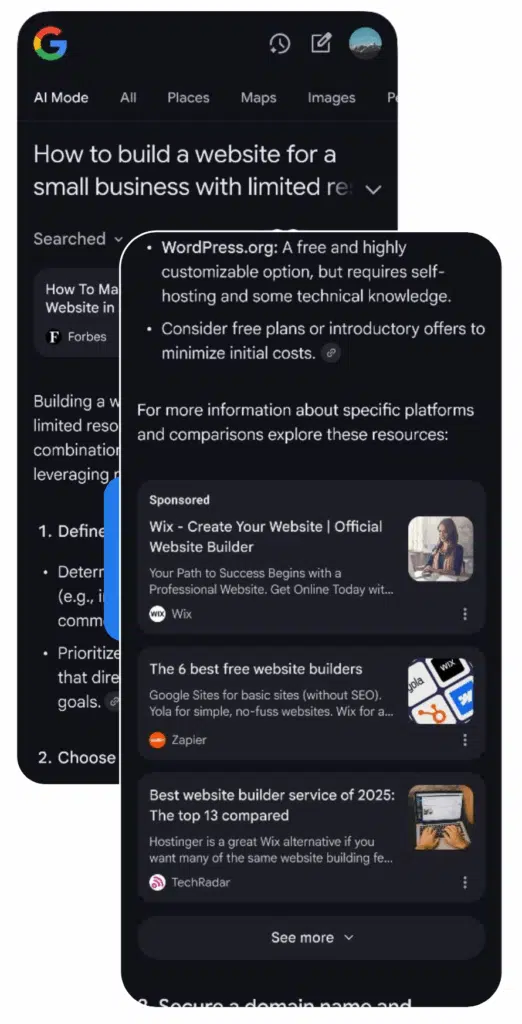
Example of SERP display with SEA results (source: official Google documentation)
These ads take into account not only the user's query, but also the content produced by the AI. For example, if a user asks "best hiking boots for beginners", the generative block can propose a synthetic answer and, right next to it, display Shopping or Search ads targeting specific products. This makes it possible to shorten the path to purchase and capture attention at the exact moment of intention.
The advertising formats concerned include :
- Text Ads (classic search ads),
- Shopping Ads (from product flows),
- Local & App Ads (local campaigns and applications),
- and campaigns Performance Max (PMax)with native integration into AI experiences
For advertisers, this implies two major changes:
- Increased automation Google recommends using its AI-driven targeting solutions (Broad Match, AI Max for Search, Performance Max, etc.), capable of going beyond traditional keywords and covering emerging queries thanks to a better understanding of language and intent.
- More stringent quality requirements for product flows for retailers, Google insists on the importance of feed hygieneto keep Shopping feeds perfectly up to date (prices, availability, images) so as to be eligible for integration into SGE
In short, AI doesn't make ads disappear; on the contrary, it repositions them at the heart of the user experience, at the moment when the surfer is exploring a topic and about to take action. For brands, this means that ATS remains a key lever - but it needs to be rethought in light of these new locations, increasing automation and synergy with generative content.
🔍 Also read: DeepSeek vs ChatGPT: AI and generative SEO - find out how these models influence future SEO strategies.


